The novel
The Eastern Rooms
Dhaka, 1946–1982
Status: Review and translation
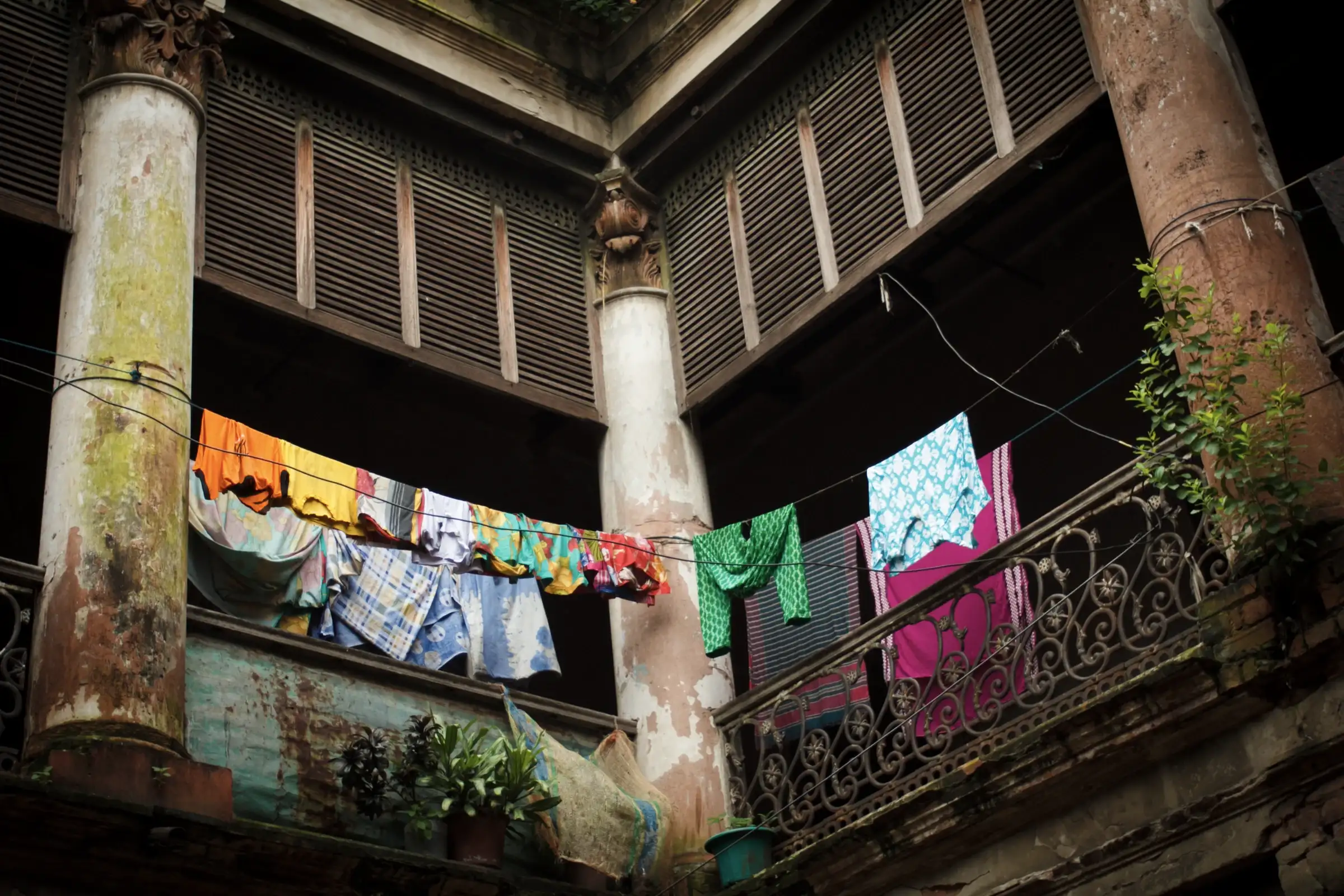
The Eastern Rooms is a family saga set mostly inside one house in old Dhaka. It follows three generations from 1946, the year before Partition, to 1982, a decade after the war that created Bangladesh.
By then the house is old and expensive to keep, and there is talk of selling it. Before anyone can, the family has to agree on what belongs to whom, and that depends on agreeing about what happened in its rooms.
It is written for readers who know Bangladesh well, and for readers who know almost nothing about it.
Read the opening
Chapter One · 1982 · Original English
The key went in halfway and stopped. Maya drew it out, turned it over, and tried again. Behind her, in the courtyard, her father asked whether she was certain it was the right one.
“There are three doors,” she said. “You’ve given me three keys.”
“That wasn’t what I asked.”
She took her hand from the lock. Kamal stood beneath the veranda with the inventory book tucked under his arm. He had taken his shoes off at the entrance and was standing on one of Mariam’s washed squares of matting, as if he were a visitor who might be asked to stay. Nothing in the house had yet been packed. The washing was on its line. Two cups waited on the sill outside the kitchen. But a man was coming on Thursday to see whether he wanted to buy it, and already Kamal had begun to behave as if every object had to account for its presence.
They had agreed to open the room before the viewing. Laila wanted her table out; Maya had come ahead to list what she could reach. On the old repairs page she had brought with her, the table’s condition was still blank.
“It’s the key,” Maya said. “The lock has gone stiff.”
“Then leave it. Write down that there’s a room.”
“That won’t take long.”
“There are other rooms to count.”
He held out the book. It was one of the shop ledgers, made for columns of credit and payment. Kamal had crossed out the printed heading and written House over it in his small, upright hand. Maya had been asked to list the furniture and the things that could be carried away. He wanted two copies by Thursday: one for the family, one in case the buyer asked what would remain. Maya had said she could do it in an afternoon. At the time she had meant the furniture.
The Eastern Rooms · Z. Karim
History, at one remove
Most people meet history indirectly, and so does this family. Partition matters because neighbours leave. A radio in the dining room carries more weight than any speech. Brothers who agreed about everything at twenty find, at forty, that they mean different things by loyalty.
The people around the house
The family is Bengali and Muslim. Their closest neighbours and friends include a Hindu family and an Urdu-speaking family. Nobody’s politics can be read from their religion or their language, including the family’s own. Within one household, some believe in Pakistan and some come to want Bangladesh, and nearly everyone is mostly trying to keep their people safe.
Five parts
The novel is arranged in five parts.
- Part 1: The Country That Arrived
- Part 2: A Language for Home
- Part 3: The Distance Between Wings
- Part 4: Nine Months
- Part 5: The Country We Made
The book is in review and translation, and there is no publication date yet. Hear when it is ready.